
The Chrome team at Google recently built a new browser. It takes a query or prompt, opens a bunch of related tabs for you, and then builds you a custom app for whatever you’re trying to do. Ask it for travel tips and it’ll build you a planner app; ask it for study help and it’ll build you a flashcard system. It’s Googling meets vibe coding. The concept is called GenTabs, and the browser is called Disco (evidently, both for fun reasons and because it’s short for “discovery”). Google is launching both as experiments in the Search Labs today, to see if they might have a place in the future of the web.
Artificial Intelligence
Google is building an experimental new browser and a new kind of web app

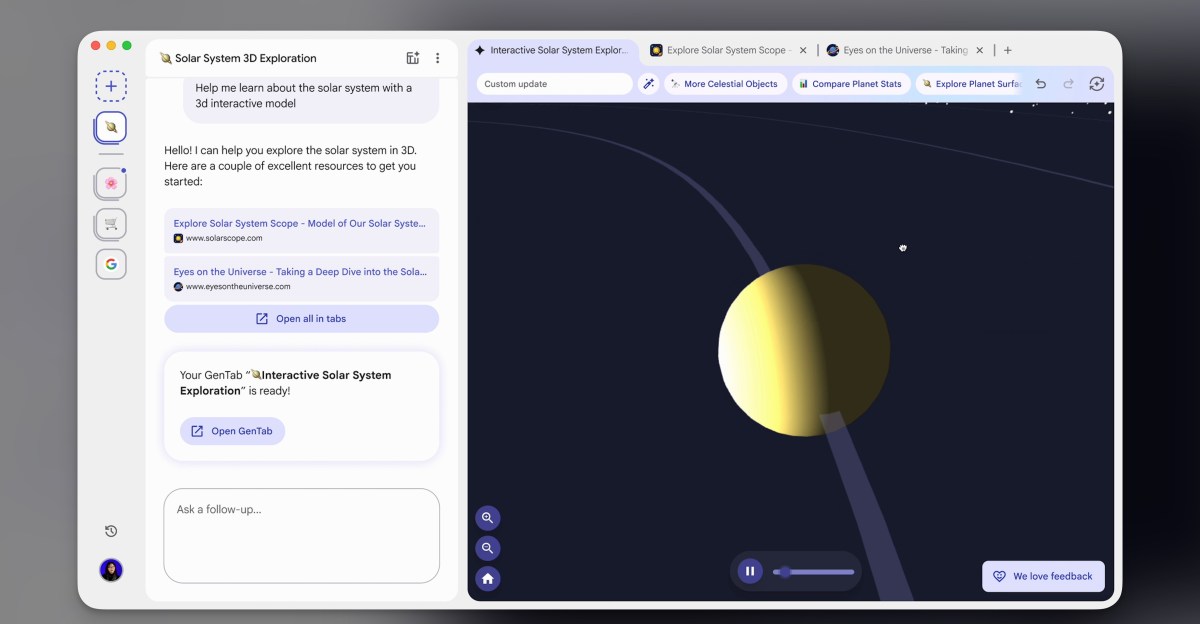
Before we get too far: No, this is not some internal attempt to cannibalize Chrome. It started as a hackathon project inside Google, and seems to have just caught the team’s imagination. “I don’t think of Disco as a general-purpose browser,” says Parisa Tabriz, who runs the Chrome team at Google. It can certainly open and interact with websites, but its real job is to see what happens when “people go from just having tabs to creating this very personalized, curated app that helps them do what they need, right now.”
GenTabs turns out to be an unexciting but reasonably descriptive term: They’re information-rich pages generated by Google’s Gemini AI models. One of the key features in the recently launched Gemini 3 is its ability to create one-off interactive interfaces, essentially building miniature apps on the fly instead of just returning a bunch of text or an image. GenTabs takes that idea and makes it the core feature of your web browser.
To demonstrate, Manini Roy, who runs an innovation lab on the Chrome team, opened up Disco and created a new tab. Well, again, not a tab exactly: She clicked a button in the app’s left sidebar that launched what Google is calling a “project,” which I can only describe as a browser inside the browser. The first thing that appeared was a chat box, into which Roy typed that she wanted to plan a trip to Japan. This is a bog-standard chatbot use case, and Gemini immediately got to work.
Rather than just deliver a bunch of text and links, Disco immediately did two things: It opened a bunch of tabs related to Roy’s query and offered to create an interactive planner for her. Roy accepted the offer, and after a minute or so of processing, Gemini created what appeared to be an interactive web app. It had a map of Japan with a bunch of relevant attractions marked, a relatively simple itinerary builder, and links to the sources it used. Those sources included the tabs open inside the project, and as Roy opened new tabs with other things she wanted to add to her trip, the GenTab updated with new information from those sources.
This back-and-forth, in which GenTabs suggest information but also consider the sites you open yourself, is key to the whole idea. Rather than prompt the model to keep offering you more stuff, you’re supposed to add stuff yourself! Open a bunch of tabs with the places you know you want to go in Japan, and the GenTab can drop them into the itinerary along with the places it suggests for you. It’s much more collaborative than the set-and-forget idea behind so many agentic systems.
Roy showed me other demos, too, including one that answered a question about how ankles work, both by opening tabs with helpful medical information and by creating a GenTab with a very unpolished but pretty helpful interactive model of the human foot. Another project was designed to help you with a cross-country move, and included moving tips, a calculator to weigh your stuff, and a price comparison table for various moving companies. In every case, the GenTab offers a bunch of tips for how you might tweak or refine the interface, plus a text box for following up however you’d like.
Disco is one of the most web-forward AI demos I’ve ever seen, in that unlike most AI browsers it appears to actually hope you open and look at websites. At first, Roy says, “we surfaced the links in the chat, but never opened the tabs. And what we found is that a lot of users kept chatting, but weren’t necessarily going into the tabs and digging into the sources.” The team wanted to incentivize users to add more information and research to the GenTab, so they needed to get them to open some regular tabs. “That is where the grounding is that the GenTabs are using to create themselves,” she says. “That’s creating the virtuous cycle.” So far, she says early data suggests pushing people to use the web instead of just the chatbot is already working.

The biggest question about GenTabs is simply: What is a GenTab? Is it a web app that sticks around forever and has a URL you can go to yourself and share with others? Is it something ephemeral that disappears when you close it? Tabriz says she’s not exactly sure. “We have two new primitives here, right?” she asks. “One is this concept of a project, which is a container that’s holding a chat conversation with a bunch of regular tabs with content from the open internet. And then there’s this generated tab, which has taken all this information and turned it into essentially a web app that weaved all of this together to help you get something done.”
Early users, Tabriz says, have asked for ways to share their GenTabs with others or make them permanent in other ways. When I mention that Google has many apps, like Docs and Sheets, that let users do this in fairly understandable ways, she laughs and nods. She says the answer is probably to support both permanence and ephemerality, plus to offer ways to get important data out of GenTabs and into other tools people use. (Like, for instance, all the Google Workspace apps.)
Both Roy and Tabriz seem genuinely curious and uncertain about how Disco will turn out. Will people embrace what amounts to vibe-coding one-off web apps? Will they understand the concept of a back-and-forth between web tabs and GenTabs? Do GenTabs ultimately make more sense as their own app — a sort of project management tool — or as a feature of Chrome or Search or Docs or something else? They don’t know. Hence the experiment. But more than just about any AI browser I’ve seen, Disco feels like it is both AI and web browser. And if it can put those two things together to make something even better, well, maybe it can take on Chrome.
Follow topics and authors from this story to see more like this in your personalized homepage feed and to receive email updates.
Continue Reading
Artificial Intelligence
Ronnie Sheth, CEO, SENEN Group: Why now is the time for enterprise AI to ‘get practical'

Before you set sail on your AI journey, always check the state of your data – because if there is one thing likely to sink your ship, it is data quality.
Gartner estimates that poor data quality costs organisations an average of $12.9 million each year in wasted resources and lost opportunities. That’s the bad news. The good news is that organisations are increasingly understanding the importance of their data quality – and less likely to fall into this trap.
That’s the view of Ronnie Sheth, CEO of AI strategy, execution and governance firm SENEN Group. The company focuses on data and AI advisory, operationalisation and literacy, and Sheth notes she has been in the data and AI space ‘ever since [she] was a corporate baby’, so there is plenty of real-world experience behind the viewpoint. There is also plenty of success; Sheth notes that her company has a 99.99% client repeat rate.
“If I were to be very practical, the one thing I’ve noticed is companies jump into adopting AI before they’re ready,” says Sheth. Companies, she notes, will have an executive direction insisting they adopt AI, but without a blueprint or roadmap to accompany it. The result may be impressive user numbers, but with no measurable outcome to back anything up.
Even as recently as 2024, Sheth saw many organisations struggling because their data was ‘nowhere where it needed to be.’ “Not even close,” she adds. Now, the conversation has turned more practical and strategic. Companies are realising this, and coming to SENEN Group initially to get help with their data, rather than wanting to adopt AI immediately.
“When companies like that come to us, the first course of order is really fixing their data,” says Sheth. “The next course of order is getting to their AI model. They are building a strong foundation for any AI initiative that comes after that.
“Once they fix their data, they can build as many AI models as they want, and they can have as many AI solutions as they want, and they will get accurate outputs because now they have a strong foundation,” Sheth adds.
With breadth and depth in expertise, SENEN Group allows organisations to right their course. Sheth notes the example of one customer who came to them wanting a data governance initiative. Ultimately, it was the data strategy which was needed – the why and how, the outcomes of what they were trying to do with their data – before adding in governance and providing a roadmap for an operating model. “They’ve moved from raw data to descriptive analytics, moving into predictive analytics, and now we’re actually setting up an AI strategy for them,” says Sheth.
It is this attitude and requirement for practical initiatives which will be the cornerstone of Sheth’s discussion at AI & Big Data Expo Global in London this week. “Now would be the time to get practical with AI, especially enterprise AI adoption, and not think about ‘look, we’re going to innovate, we’re going to do pilots, we’re going to experiment,’” says Sheth. “Now is not the time to do that. Now is the time to get practical, to get AI to value. This is the year to do that in the enterprise.”
Watch the full video conversation with Ronnie Sheth below:

Greg Holmes, Field CTO for EMEA at Apptio, an IBM company, argues that successfully scaling intelligent automation requires financial rigour.
The “build it and they will come” model of technology adoption often leaves a hole in the budget when applied to automation. Executives frequently find that successful pilot programmes do not translate into sustainable enterprise-wide deployments because initial financial modelling ignored the realities of production scaling.
“When we integrate FinOps capabilities with automation, we’re looking at a change from being very reactive on cost management to being very proactive around value engineering,” says Holmes.
This shifts the assessment criteria for technical leaders. Rather than waiting “months or years to assess whether things are getting value,” engineering teams can track resource consumption – such as cost per transaction or API call – “straight from the beginning.”
The unit economics of scaling intelligent automation
Innovation projects face a high mortality rate. Holmes notes that around 80 percent of new innovation projects fail, often because financial opacity during the pilot phase masks future liabilities.
“If a pilot demonstrates that automating a process saves, say, 100 hours a month, leadership thinks that’s really successful,” says Holmes. “But what it fails to track is that the pilot sometimes is running on over-provisioned infrastructure, so it looks like it performs really well. But you wouldn’t over-provision to that degree during a real production rollout.”
Moving that workload to production changes the calculus. The requirements for compute, storage, and data transfer increase. “API calls can multiply, exceptions and edge cases appear at volume that might have been out of scope for the pilot phase, and then support overheads just grow as well,” he adds.
To prevent this, organisations must track the marginal cost at scale. This involves monitoring unit economics, such as the cost per customer served or cost per transaction. If the cost per customer increases as the customer base grows, the business model is flawed.
Conversely, effective scaling should see these unit costs decrease. Holmes cites a case study from Liberty Mutual where the insurer was able to find around $2.5 million of savings by bringing in consumption metrics and “not just looking at labour hours that they were saving.”
However, financial accountability cannot sit solely with the finance department. Holmes advocates for putting governance “back in the hands of the developers into their development tools and workloads.”
Integration with infrastructure-as-code tools like HashiCorp Terraform and GitHub allows organisations to enforce policies during deployment. Teams can spin up resources programmatically with immediate cost estimates.
“Rather than deploying things and then fixing them up, which gets into the whole whack-a-mole kind of problem,” Holmes explains, companies can verify they are “deploying the right things at the right time.”
When scaling intelligent automation, tension often simmers between the CFO, who focuses on return on investment, and the Head of Automation, who tracks operational metrics like hours saved.
“This translation challenge is precisely what TBM (Technology Business Management) and Apptio are designed to solve,” says Holmes. “It’s having a common language between technology and finance and with the business.”
The TBM taxonomy provides a standardised framework to reconcile these views. It maps technical resources (such as compute, storage, and labour) into IT towers and further up to business capabilities. This structure translates technical inputs into business outputs.
“I don’t necessarily know what goes into all the IT layers underneath it,” Holmes says, describing the business user’s perspective. “But because we’ve got this taxonomy, I can get a detailed bill that tells me about my service consumption and precisely which costs are driving it to be more expensive as I consume more.”
Addressing legacy debt and budgeting for the long-term
Organisations burdened by legacy ERP systems face a binary choice: automation as a patch, or as a bridge to modernisation. Holmes warns that if a company is “just trying to mask inefficient processes and not redesign them,” they are merely “building up more technical debt.”
A total cost of ownership (TCO) approach helps determine the correct strategy. The Commonwealth Bank of Australia utilised a TCO model across 2,000 different applications – of various maturity stages – to assess their full lifecycle costs. This analysis included hidden costs such as infrastructure, labour, and the engineering time required to keep automation running.
“Just because of something’s legacy doesn’t mean you have to retire it,” says Holmes. “Some of those legacy systems are worth maintaining just because the value is so good.”
In other cases, calculating the cost of the automation wrappers required to keep an old system functional reveals a different reality. “Sometimes when you add up the TCO approach, and you’re including all these automation layers around it, you suddenly realise, the real cost of keeping that old system alive is not just the old system, it’s those extra layers,” Holmes argues.
Avoiding sticker shock requires a budgeting strategy that balances variable costs with long-term commitments. While variable costs (OPEX) offer flexibility, they can fluctuate wildly based on demand and engineering efficiency.
Holmes advises that longer-term visibility enables better investment decisions. Committing to specific technologies or platforms over a multi-year horizon allows organisations to negotiate economies of scale and standardise architecture.
“Because you’ve made those longer term commitments and you’ve standardised on different platforms and things like that, it makes it easier to build the right thing out for the long term,” Holmes says.
Combining tight management of variable costs with strategic commitments supports enterprises in scaling intelligent automation without the volatility that often derails transformation.
IBM is a key sponsor of this year’s Intelligent Automation Conference Global in London on 4-5 February 2026. Greg Holmes and other experts will be sharing their insights during the event. Be sure to check out the day one panel session, Scaling Intelligent Automation Successfully: Frameworks, Risks, and Real-World Lessons, to hear more from Holmes and swing by IBM’s booth at stand #362.
See also: Klarna backs Google UCP to power AI agent payments

Want to learn more about AI and big data from industry leaders? Check out AI & Big Data Expo taking place in Amsterdam, California, and London. The comprehensive event is part of TechEx and is co-located with other leading technology events including the Cyber Security & Cloud Expo. Click here for more information.
AI News is powered by TechForge Media. Explore other upcoming enterprise technology events and webinars here.

FedEx is using AI to change how package tracking and returns work for large enterprise shippers. For companies moving high volumes of goods, tracking no longer ends when a package leaves the warehouse. Customers expect real-time updates, flexible delivery options, and returns that do not turn into support tickets or delays.
That pressure is pushing logistics firms to rethink how tracking and returns operate at scale, especially across complex supply chains.
This is where artificial intelligence is starting to move from pilot projects into daily operations.
FedEx plans to roll out AI-powered tracking and returns tools designed for enterprise shippers, according to a report by PYMNTS. The tools are aimed at automating routine customer service tasks, improving visibility into shipments, and reducing friction when packages need to be rerouted or sent back.
Rather than focusing on consumer-facing chatbots, the effort centres on operational workflows that sit behind the scenes. These are the systems enterprise customers rely on to manage exceptions, returns, and delivery changes without manual intervention.
How FedEx is applying AI to package tracking
Traditional tracking systems tell customers where a package is and when it might arrive. AI-powered tracking takes a step further by utilising historical delivery data, traffic patterns, weather conditions, and network constraints to flag potential delays before they happen.
According to the PYMNTS report, FedEx’s AI tools are designed to help enterprise shippers anticipate issues earlier in the delivery process. Instead of reacting to missed delivery windows, shippers may be able to reroute packages or notify customers ahead of time.
For businesses that ship thousands of parcels per day, that shift matters. Small improvements in prediction accuracy can reduce support calls, lower refund rates, and improve customer trust, particularly in retail, healthcare, and manufacturing supply chains.
This approach also reflects a broader trend in enterprise software, in which AI is being embedded into existing systems rather than introduced as standalone tools. The goal is not to replace logistics teams, but to minimise the number of manual decisions they need to make.
Returns as an operational problem, not a customer issue
Returns are one of the most expensive parts of logistics. For enterprise shippers, particularly those in e-commerce, returns affect warehouse capacity, inventory planning, and transportation costs.
According to PYMNTS, FedEx’s AI-enabled returns tools aim to automate parts of the returns process, including label generation, routing decisions, and status updates. Companies that use AI to determine the most efficient return path may be able to reduce delays and avoid returning things to the wrong facility.
This is less about convenience and more about operational discipline. Returns that sit idle or move through the wrong channel create cost and uncertainty across the supply chain. AI systems trained on past return patterns can help standardise decisions that were previously handled case by case.
For enterprise customers, this type of automation supports scale. As return volumes fluctuate, especially during peak seasons, systems that adjust automatically reduce the need for temporary staffing or manual overrides.
What FedEx’s AI tracking approach says about enterprise adoption
What stands out in FedEx’s approach is how narrowly focused the AI use case is. There are no broad claims about transformation or reinvention. The emphasis is on reducing friction in processes that already exist.
This mirrors how other large organisations are adopting AI internally. In a separate context, Microsoft described a similar pattern in its article. The company outlined how AI tools were rolled out gradually, with clear limits, governance rules, and feedback loops.
While Microsoft’s case focused on knowledge work and FedEx’s on logistics operations, the underlying lesson is the same. AI adoption tends to work best when applied to specific activities with measurable results rather than broad promises of efficiency.
For logistics firms, those advantages include fewer delivery exceptions, lower return handling costs, and better coordination between shipping partners and enterprise clients.
What this signals for enterprise customers
For end-user companies, FedEx’s move signals that logistics providers are investing in AI as a way to support more complex shipping demands. As supply chains become more distributed, visibility and predictability become harder to maintain without automation.
AI-driven tracking and returns could also change how businesses measure logistics performance. Companies may focus less on delivery speed and more on how quickly issues are recognised and resolved.
That shift could influence procurement decisions, contract structures, and service-level agreements. Enterprise customers may start asking not just where a shipment is, but how well a provider anticipates problems.
FedEx’s plans reflect a quieter phase of enterprise AI adoption. The focus is less on experimentation and more on integration. These systems are not designed to draw attention but to reduce noise in operations that customers only notice when something goes wrong.
(Photo by Liam Kevan)
See also: PepsiCo is using AI to rethink how factories are designed and updated
Want to learn more about AI and big data from industry leaders? Check out AI & Big Data Expo taking place in Amsterdam, California, and London. The comprehensive event is part of TechEx and is co-located with other leading technology events, click here for more information.
AI News is powered by TechForge Media. Explore other upcoming enterprise technology events and webinars here.
-

 Fintech6 months ago
Race to Instant Onboarding Accelerates as FDIC OKs Pre‑filled Forms | PYMNTS.com
-

 Cyber Security7 months ago
Hackers Use GitHub Repositories to Host Amadey Malware and Data Stealers, Bypassing Filters
-
Fintech6 months ago
DAT to Acquire Convoy Platform to Expand Freight-Matching Network’s Capabilities | PYMNTS.com
-

 Fintech5 months ago
ID.me Raises $340 Million to Expand Digital Identity Solutions | PYMNTS.com
-

 Artificial Intelligence7 months ago
Nothing Phone 3 review: flagship-ish
-

 Artificial Intelligence7 months ago
The best Android phones
-
 Fintech4 months ago
Tracking the Convergence of Payments and Digital Identity | PYMNTS.com
-

 Fintech7 months ago
Intuit Adds Agentic AI to Its Enterprise Suite | PYMNTS.com