
Artificial Intelligence
AI adoption in financial services has hit a point of no return


AI adoption in financial services has effectively become universal–and the institutions still treating it as an experiment are now the outliers. According to Finastra’s Financial Services State of the Nation 2026 report, which surveyed 1,509 senior executives across 11 markets, only 2% of financial institutions globally report no use of AI whatsoever.
The debate is over. The question now is what comes next. For CIOs and technology leaders, the findings paint a picture that is equal parts opportunity and pressure. Six in ten institutions improved their AI capabilities over the past year, with 43% citing AI as their single most important innovation lever.
From fraud detection and document intelligence to compliance automation and customer engagement, AI has quietly embedded itself across the entire financial value chain. But near-universal adoption also means that deployment alone is no longer a differentiator.
From pilots to pressure
The report identifies a clear shift in how institutions are thinking about AI. The early conversation–whether to adopt, which use cases to try, how much to invest–has given way to something more operationally complex. Institutions are now focused on scaling AI responsibly, governing it effectively, and making it work reliably across enterprise-wide functions rather than in isolated pockets.
The top four use cases where institutions are either running programmes or piloting AI reflect that maturity: risk management and fraud detection (71%), data analysis and reporting (71%), customer service and support assistants (69%), and document intelligence management (69%).
These are not peripheral functions. They sit at the core of how financial institutions operate and compete. Looking ahead, the three priorities that dominate the next phase are: AI-driven personalisation, agentic AI for workflow automation, and AI model governance and explainability.
That last one deserves attention. As AI decisions become more consequential–and more scrutinised–the ability to explain, audit, and stand behind those decisions is fast becoming a regulatory and reputational imperative, not just a technical nicety.
The infrastructure problem
High adoption numbers can obscure an inconvenient truth: AI is only as capable as the systems underneath it. Finastra’s data makes this link explicit. Nearly nine in ten institutions (87%) plan to invest in modernisation over the next 12 months, driven precisely by the need to scale AI effectively. Cloud adoption, data platform modernisation, and core banking upgrades are all accelerating–not as standalone initiatives, but as the foundational layer that determines how far and how fast AI can actually go.
The barriers, however, remain stubbornly human. Talent shortages are cited by 43% of institutions as the primary obstacle to progress, with the challenge particularly acute in Singapore (54%), the UAE (51%), and Japan and the US (both at 50%).
Budget constraints follow closely behind. The institutions pulling ahead are increasingly turning to fintech partnerships–now the default modernisation strategy for 54% of respondents–to close those gaps without bearing the full cost of building in-house.
The regional picture
Across the Asia-Pacific, the data reflects distinct priorities. Vietnam leads on active AI deployment at 74%, driven by the urgency of financial inclusion and the need for faster payment and lending processing. Singapore is aggressively scaling cloud and personalisation investment, with planned spending increases above 50% year-on-year.
Japan, meanwhile, remains the most cautious market surveyed, with only 39% reporting active AI deployment — a reflection of legacy constraints and a cultural preference for incremental over rapid change.
Governance is the next frontier
With 63% of institutions already running or piloting agentic AI programmes, the technology’s trajectory is clear. But so is the challenge it brings. Agentic AI–systems capable of autonomous decision-making and multi-step task execution–raises the stakes considerably on questions of accountability, transparency, and control.
For enterprise leaders, the coming year is less about whether to invest in AI and more about how to do so in a way that regulators, customers, and boards can trust. As Chris Walters, CEO of Finastra, put it: institutions are expected to move quickly, but also responsibly, as regulatory scrutiny increases and customers demand financial services that work reliably, securely, and personally every time.
The tipping point has been crossed. What institutions do with that momentum–and how carefully they govern it–will define the competitive landscape for the rest of the decade.
Finastra’s Financial Services State of the Nation 2026 report surveyed 1,509 managers and executives from banks and financial institutions across France, Germany, Hong Kong, Japan, Mexico, Saudi Arabia, Singapore, the UAE, the UK, the US, and Vietnam. Research was conducted by Savanta in November 2025.
(Photo by PR Newswire)
See also: How financial institutions are embedding AI decision-making
Want to learn more about AI and big data from industry leaders? Check out AI & Big Data Expo taking place in Amsterdam, California, and London. The comprehensive event is part of TechEx and is co-located with other leading technology events including the Cyber Security & Cloud Expo. Click here for more information.
AI News is powered by TechForge Media. Explore other upcoming enterprise technology events and webinars here.AI adoption in financial services
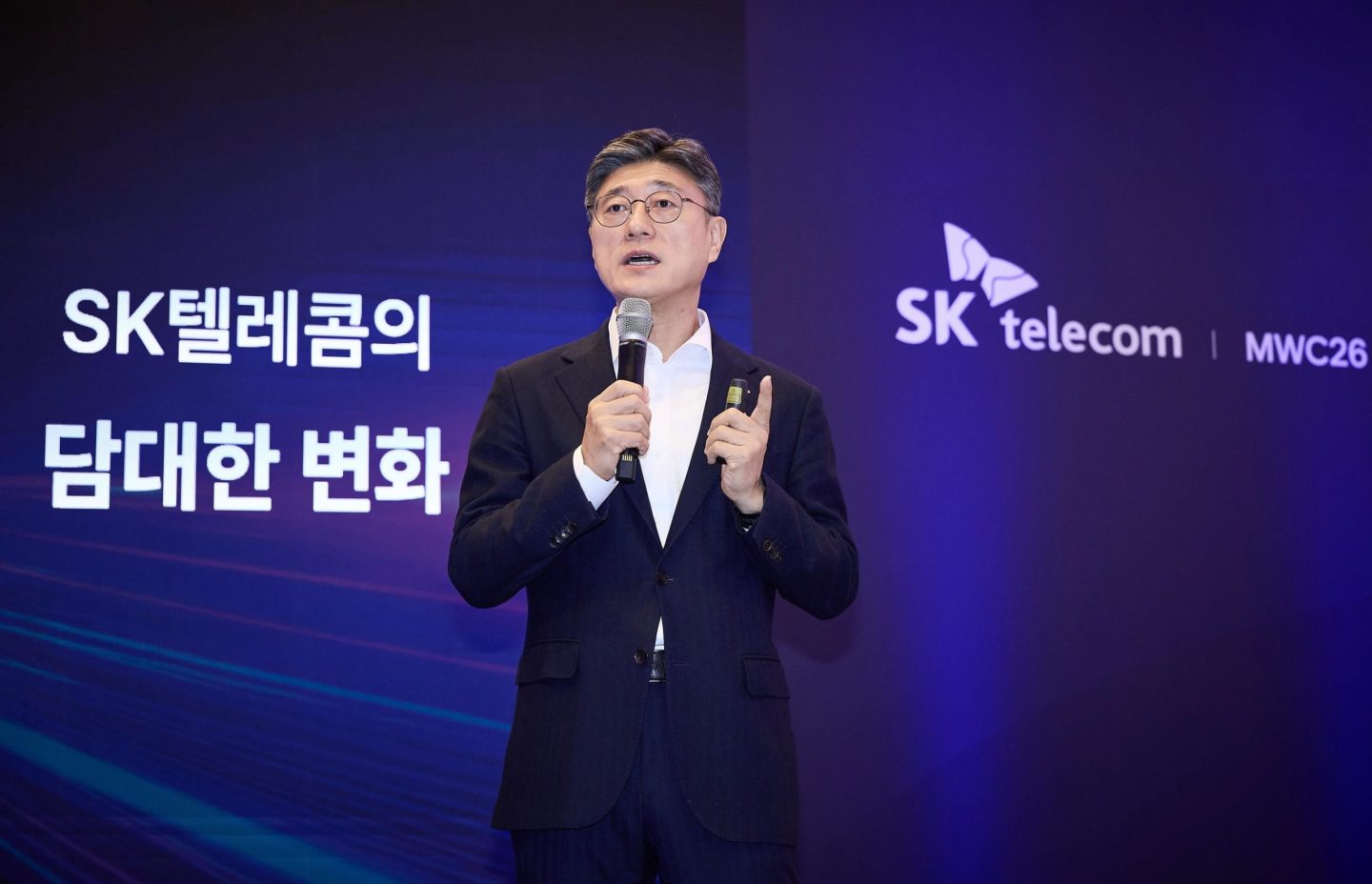
At MWC 2026 in Barcelona, SK Telecom outlined how it is rebuilding itself around AI, from its network core to its customer service desks. The shift goes beyond adding new AI tools. It involves rewriting internal systems, expanding data centre capacity to the gigawatt scale, and upgrading its own large language model to more than one trillion parameters.
At a press conference during MWC 2026, SK Telecom CEO Jung Jai-hun outlined what the company calls an “AI Native” strategy. The plan centres on reorganising infrastructure and making large investments so the company can help position Korea among the world’s top three AI powers.
“SKT is currently at a golden time of transformation, where the two tasks of ‘customer value innovation’ and ‘AI innovation’ intersect in a borderless, converged environment that goes beyond telecommunications,” Jung said. “SKT defines ‘the customer as the very essence of our business,’ and through innovation driven by AI, we will evolve into a company that makes meaningful contributions to our customers and to Korea.”
Rewriting telecom systems around AI at MWC 2026
At the core of the plan is a rebuild of SK Telecom’s integrated IT systems. The company said it will redesign sales, line management, and billing systems to be optimised for AI. The aim is to let the operator design and offer personalised plans and memberships based on each customer’s usage and behaviour patterns.
The company also plans to apply a Zero Trust security framework across its systems. This will include stronger authentication, access controls, network segmentation, and AI-based monitoring, according to the company’s briefing at MWC 2026.
For enterprises watching the telecom sector, this signals a broader shift. Telecom operators have long relied on legacy billing stacks and network management tools. Rebuilding those systems around AI could change how pricing, service design, and fault detection work in practice. It also raises questions about data governance and how customer data is used to train or tune AI models.
SK Telecom is also expanding its “autonomous network operations” strategy. The company said it will use AI to automate wireless quality management, traffic control, and network equipment operations. With AI-RAN technology, it aims to improve speed and reduce latency. These efforts were described in company materials shared during the press event.
A single AI agent across touchpoints
Another part of the strategy focuses on customer interaction. SK Telecom plans to redesign pricing, roaming, and membership services to make them simpler and more automated. It is developing what it calls an integrated AI agent to connect experiences across its main customer portal, T world, and its online store, T Direct Shop.
The company said the agent will analyse daily usage patterns and offer tailored suggestions across channels. It also plans to expand its AI Contact Center so customer service representatives can use AI tools during support calls.
Offline retail stores are part of the shift. SK Telecom said AI will help staff identify customer needs and offer recommendations after a store visit. It is also building “AI Personas” to analyse digital behaviour across customer segments and support conversational Q&A.
For enterprise leaders, this mirrors a wider pattern. Telecom operators are trying to move from reactive service models to predictive ones. The difference now is scale. By embedding AI into billing, customer service, and retail, SK Telecom is treating AI as an operating layer rather than a separate feature.
Building 1GW-class AI data centres
The infrastructure build-out is equally ambitious. SK Telecom said it will construct hyperscale AI data centres across Korea, targeting capacity that exceeds 1 gigawatt. It aims to attract global investment and position the country as a major AI data centre hub in Asia.
The company already operates a GPU cluster called Haein and applied its virtualisation solution, Petasus AI Cloud, to support GPU-as-a-service workloads last year. It now plans to offer that cloud solution globally.
SK Telecom also plans to build an AI data centre in Korea’s southwestern region in collaboration with OpenAI, according to the company’s announcement at MWC 2026.
On the model side, SK Telecom said its sovereign AI foundation model currently has 519 billion parameters, making it the largest in Korea. The company plans to upgrade it to more than one trillion parameters and add multimodal capabilities so it can process image, voice, and video data starting in the second half of the year.
CEO Jung framed the data centre and model build-out in national terms. “AIDC can be seen as the heart of Korea, and hyperscale LLMs as the brain,” he said. “By combining SKT’s AI capabilities with collaboration from domestic and global partners, we will lead true AI-native transformation for Korean customers and enterprises.”
For enterprise readers, the key issue is not parameter count alone. It is how such models will be applied in sectors like manufacturing. SK Telecom said it is working with SK hynix on a manufacturing-focused AI package that analyses process data in real time to reduce defect rates and improve equipment efficiency. The package will be offered as infrastructure, model, and solution.
Changing internal culture
The transformation also extends to internal operations. SK Telecom has built an “AX Dashboard” to track AI use across departments and individuals. It operates an “AI Board” to oversee AI transformation efforts and has created an “AI playground” where employees can build AI agents without coding. More than 2,000 AI agents are already in use across marketing, legal, and public relations, according to the company’s figures shared at the event.
“To drive future growth, we must reinvent our way of working from the ground up. SKT will fundamentally transform its corporate culture to be centred around AI,” Jung said.
For other enterprises, the takeaway is less about branding and more about structure. SK Telecom is tying infrastructure, models, applications, and internal governance into a single program. Whether it can execute at the scale it describes remains to be seen. What is clear is that AI is no longer positioned as a side project. It is becoming the operating model.
(Photo by PR Newswire)
See also: Nokia and AWS pilot AI automation for real-time 5G network slicing
Want to learn more about AI and big data from industry leaders? Check out AI & Big Data Expo taking place in Amsterdam, California, and London. The comprehensive event is part of TechEx and is co-located with other leading technology events including the Cyber Security & Cloud Expo. Click here for more information.
AI News is powered by TechForge Media. Explore other upcoming enterprise technology events and webinars here.

Many organisations are eroding the foundations of business – productivity, competitiveness, and efficiency. This is happening due to poor implementation of human-AI collaboration, according to cloud data and AI consultancy, Datatonic. The company says in the next phase of enterprise AI, success will come from carefully-governed and designed AI that works alongside humans in “human-in-the-loop (HiTL)’ systems.
The company’s research shows that companies that fail to embed AI into their human workflows are falling behind the competition as productivity slows down. Datatonic says a hybrid human-AI approach speeds up decision-making, thus improving overall operations. Scott Eivers, CEO of Datatonic says, “AI [is] about redesigning how work gets done. The biggest risk we see in the market is productivity leakage when AI exists in isolation from the people who actually run the business.”
After years of AI investment, pressure is mounting on businesses to show returns. However, some research shows some initiatives remaining in their pilot stage due to limited trust among users. As a result, organisations are failing to use AI-powered insights to positively affect decisions and workflows, meaning efficiency gains never materialise.
According to Datatonic, HiTL models are crucial for future success, providing a combination of AI speed with human judgement and accountability. This is evident in agent-assisted software development, where AI systems create code from loose prompts and transform them into code. In this case, human teams decide what needs to be developed, inspect all requirements, and review plans before being brought into existence. Once this direction is clear, AI agents construct modular components.
The trend for AI in the workplace is starting to appear in finance and operations. For instance, in back-office and finance departments, AI-powered document processing is already delivering a 70% reduction in invoice-processing costs according to some, but finance teams still approve the final outcomes.
“They’re partnership stories,” says Andrew Harding, CTO of Datatonic. “Humans create evaluation systems, validate plans, set guardrails, and make decisions. AI executes at speed and scale. That combination is where real enterprise value shows up.”
Many enterprises are failing to deploy fully autonomous agents safely, according to Datatonic, with shortfalls in security controls and governance frameworks. Autonomy can only scale when organisations introduce approval checkpoints and benchmark performance standards. Evaluation systems must also be implemented as AI models evolve, ensuring they always operate safely and as intended without violating any compliance obligations.
Harding says, “As trust builds, companies can responsibly delegate more to AI. But skipping governance doesn’t build speed, it creates risk.”
Datatonic predicts major acceleration in workloads in the next two years, with preparation and validation handled by AI agents. AI systems may also be implemented to test and invalidate decisions before teams invest resources.
Scott Eivers believes the future “looks like expert departments run by smaller, nimble teams – finance, HR, marketing – each amplified by AI. The companies that win will be those that teach people to work with AI — not around it,” he said.
(Image source: “Waterfall” by PMillera4 is licensed under CC BY-NC-ND 2.0.)
Want to learn more about AI and big data from industry leaders? Check out AI & Big Data Expo taking place in Amsterdam, California, and London. The comprehensive event is part of TechEx and co-located with other leading technology events. Click here for more information.
AI News is powered by TechForge Media. Explore other upcoming enterprise technology events and webinars here.

Improving trust in agentic AI for finance workflows remains a major priority for technology leaders today.
Over the past two years, enterprises have rushed to put automated agents into real workflows, spanning customer support and back-office operations. These tools excel at retrieving information, yet they often struggle to provide consistent and explainable reasoning during multi-step scenarios.
Solving the automation opacity problem
Financial institutions especially rely on massive volumes of unstructured data to inform investment memos, conduct root-cause investigations, and run compliance checks. When agents handle these tasks, any failure to trace exact logic can lead to severe regulatory fines or poor asset allocation. Technology executives often find that adding more agents creates more complexity than value without better orchestration.
Open-source AI laboratory Sentient launched Arena today, which is designed as a live and production-grade stress-testing environment that allows developers to evaluate competing computational approaches against demanding cognitive problems.
Sentient’s system replicates the reality of corporate workflows, deliberately feeding agents incomplete information, ambiguous instructions, and conflicting sources. Instead of scoring whether a tool generated a correct output, the platform records the full reasoning trace to help engineering teams debug failures over time.
Building reliable agentic AI systems for finance
Evaluating these capabilities before production deployment has attracted no shortage of institutional interest. Sentient has partnered with a cohort including Founders Fund, Pantera, and asset management giant Franklin Templeton, which oversees more than $1.5 trillion. Other participants in the initial phase include alphaXiv, Fireworks, Openhands, and OpenRouter.
Julian Love, Managing Principal at Franklin Templeton Digital Assets, said: “As companies look to apply AI agents across research, operations, and client-facing workflows, the question is no longer whether these systems are powerful or if they can generate an answer, but whether they’re reliable in real workflows.
“A sandbox environment like Arena – where agents are tested on real, complex workflows, and their reasoning can be inspected – will help the ecosystem separate promising ideas from production-ready capabilities and boost confidence in how this technology is integrated and scaled.”
Himanshu Tyagi, Co-Founder of Sentient, added: “AI agents are no longer an experiment inside the enterprise; they’re being put into workflows that touch customers, money, and operational outcomes.
“That shift changes what matters. It’s not enough for a system to be impressive in a demo. Enterprises need to know whether agents can reason reliably in production, where failures are expensive, and trust is fragile.”
Organisations in sensitive industries like finance require repeatability, comparability, and a method to track reliability improvements regardless of the underlying models they use for agentic AI. Incorporating platforms like Arena allows engineering directors to build resilient data pipelines while adapting open-source agent capabilities to their private internal data.
Overcoming integration bottlenecks
Survey data highlights a gap between ambition and reality. While 85 percent of businesses want to operate as agentic enterprises – and nearly three-quarters plan to deploy autonomous agents – fewer than a quarter possess mature governance frameworks.
Advancing from a pilot phase to full scale proves difficult for many. This happens because current corporate environments run an average of twelve separate agents, frequently in silos.
Open-source development models offer a path forward by providing infrastructure that enables faster experimentation. Sentient itself acts as the architect behind frameworks like ROMA and the Dobby open-source model to assist with these coordination efforts.
Focusing on computational transparency ensures that when an automated process makes a recommendation on a portfolio, human auditors can track exactly how that conclusion was reached.
By prioritising environments that record full logic traces rather than isolated right answers, technology leaders integrating agentic AI for operations like finance can secure better ROI and maintain regulatory compliance across their business.
See also: Goldman Sachs and Deutsche Bank test agentic AI for trade surveillance
Want to learn more about AI and big data from industry leaders? Check out AI & Big Data Expo taking place in Amsterdam, California, and London. The comprehensive event is part of TechEx and is co-located with other leading technology events including the Cyber Security & Cloud Expo. Click here for more information.
AI News is powered by TechForge Media. Explore other upcoming enterprise technology events and webinars here.
-

 Fintech7 months ago
Race to Instant Onboarding Accelerates as FDIC OKs Pre‑filled Forms | PYMNTS.com
-

 Fintech6 months ago
ID.me Raises $340 Million to Expand Digital Identity Solutions | PYMNTS.com
-

 Cyber Security8 months ago
Hackers Use GitHub Repositories to Host Amadey Malware and Data Stealers, Bypassing Filters
-
Fintech7 months ago
DAT to Acquire Convoy Platform to Expand Freight-Matching Network’s Capabilities | PYMNTS.com
-
 Fintech4 months ago
Tracking the Convergence of Payments and Digital Identity | PYMNTS.com
-
Fintech6 months ago
Esh Bank Unveils Experience That Includes Revenue Sharing With Customers | PYMNTS.com
-

 Artificial Intelligence8 months ago
Nothing Phone 3 review: flagship-ish
-

 Artificial Intelligence8 months ago
The best Android phones